

logo
HomeBlogs

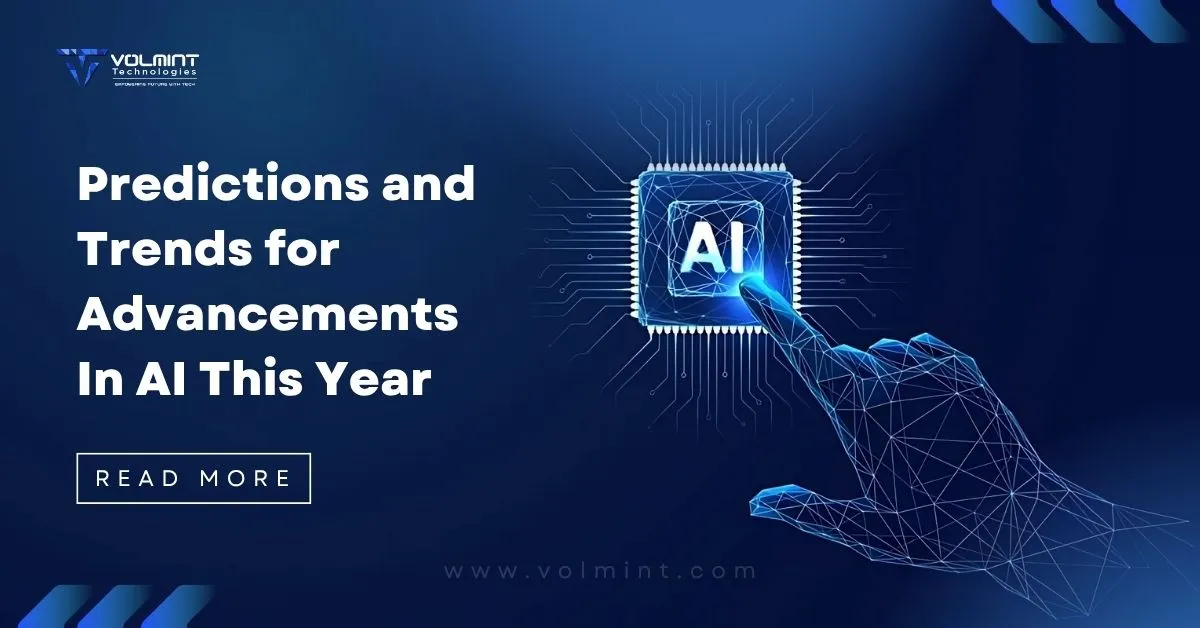
Predictions and Trends for Advancements in AI this year

Predictions and Trends for Advancements in AI this year

We have stepped into 2025 already, and the world of the internet and innovation is diversifying with each passing day. The technological revolution brings the world to the next level in which everything or anything can be possible with the essence of advancement in Artificial Intelligence or AI tools. The way AI poised for unprecedented growth and innovation since the last couple of years, especially in 2024, it’s to ponder what 2025 holds. The landscape of AI is evolving rapidly, from cutting-edge applications to ethical considerations.

AI tools dominate not only the business world but each and every field to make it more and more profitable. The ability to generate, produce, or imitate voice, text, and even video content is revolutionizing to foster innovation and stimulate creativity. As per McKinsey & Company, through a variety of commercial situations, AI applications might potentially contribute between USD 2.6 trillion and USD 4.4 trillion annually to the global economy.

We were able to see how many industries both impact and are impacted by the changing technological landscape thanks to this global viewpoint. This offers a peek at what lies next. Through this article, we explore five predictions and trends that are likely to shape the advancements in AI this year.

1. Tailoring Business AI

Market demand is highly competitive, and if a product isn't available within a specified timeframe, competitors may take advantage. To address this issue, businesses can leverage Enterprise AI to streamline production processes, automate tasks, and provide customer-centric experiences. This technology can handle large traffic volumes, use cognitive technologies, and ensure data security. By understanding customer behavior, businesses can offer products or services that customers are likely to buy or remain interested in.

Enterprise AI can automate mundane tasks, simplify complex problems, and ensure a fail-safe decision-making process. Additionally, it can predict customer demand, market behavior, and bottlenecks in existing systems, ensuring a smoother and more efficient business. By leveraging Enterprise AI, businesses can capitalize on its potential and thrive in the competitive market. Be concentrated on your growing business and explore our cutting-edge software solutions.
2. Ethical AI and Responsible Innovation:

Technology-related ethics are more than simply a catchphrase; it should inform the choices and methods. It's about making sure that the technical advancements we make protect individual rights, are consistent with our values, and advance society. As AI technologies continue to advance, ethical considerations become paramount. In 2025, the industry is expected to witness a heightened focus on ethical AI and responsible innovation.

Stakeholders, including businesses, researchers, and policymakers, will collaborate to establish guidelines and frameworks that ensure AI systems are developed and deployed ethically. This trend emphasizes transparency, fairness, and accountability in AI applications, addressing concerns related to bias, privacy, and the societal impact of AI technologies.

3. Microservices and AI powered by APIs:

Over the past several years, microservices—a software architectural methodology that helps developers build complicated systems by disassembling them into smaller, more manageable components—have grown in popularity. Artificial intelligence (AI) is becoming a crucial component of the microservices ecosystem as they gain popularity.

The widespread use of application programming interfaces (APIs) will facilitate the development of intricate AI-driven apps, increasing output in several industries. For a store, a set of unique AI microservices are available via APIs. Personalized marketing tools, inventory management, and consumer behavior research were among these offerings.

AI-driven summarization tools to quickly and intelligently make decisions by effectively analyzing sales data and consumer input. The shop was able to quickly adjust to changes in the market because of the scalability and flexibility of these API-driven solutions.

4. Cybersecurity and Safety with AI:

Concerns about AI safety and ethics are becoming increasingly pressing as AI permeates more aspects of our daily lives. To assist in ensuring ethical AI usage, top AI groups are working together to construct reliable AI systems with defined safety measures and best practices. With the increasing frequency and sophistication of cyber threats, AI is anticipated to play a crucial role in bolstering cybersecurity measures.

In 2025, we can expect the integration of AI-driven solutions for threat detection, incident response, and vulnerability management. Machine learning algorithms can analyze patterns in real time, identify anomalies, and predict potential security breaches. The proactive nature of AI in cybersecurity is crucial for staying ahead of evolving cyber threats, making it an indispensable tool for organizations across industries.

5. Open Source with AI Model:

Open-source software development projects are those that are available to the general public for use, alteration, or distribution, enabling developers, engineers, and other professionals to work together. By merging open-source pretrained AI models with private or real-time data, enterprises may leverage these models to boost growth by 2025. Both productivity and cost-efficiency are improved by this synergy.

Training corpus, cleaning and preparation of the training corpus, code used for training, trained models, inference code, and output guardrails code are all included in open-source AI. Platforms, tools, datasets, and application programming interfaces (APIs) are also included.

Significance of AI Applications

AI development, in 2025, anticipates significant advancements in all fields. Which enables machines to understand and interact with human language, and is critical for applications such as virtual assistants, language translation, and sentiment analysis. The evolution of more sophisticated and context-aware models will lead to more natural and meaningful interactions between humans and AI systems. This trend will have profound implications for customer service, content creation, and cross-cultural communication.

Conclusion

These AI applications act as a guide for progress, expansion, and progression in society. As AI develops, it forces us to reconsider both our relationships with the outside world and our corporate procedures. We can use AI to create a more productive, creative, and inclusive future if we remain aware, flexible, and proactive.

2025 holds immense promise for the field of AI, with advancements that will reshape industries, contribute to global problem-solving, and address ethical considerations. The synergy between AI and various sectors underscores the transformative potential of this technology. As these predictions and trends unfold, stakeholders must remain vigilant about the ethical implications and societal impact of AI, ensuring that innovation is aligned with the greater good.

In addition to technology advancements, the next year will see the responsible and thoughtful development of AI that benefits all of mankind. AI has enormous potential, and its effects are only getting started. Be in touch with the growing phase of technology and innovations that driven the world to the new ways of living with Volmint Technologies.

More Blogs

Let's Connect for Technological Brilliance

Reach Out to Volmint Technologies Today and Unleash the Power of Customized Solutions Tailored to Elevate Your Business.

Contact Us
Footer Background Circle