

logo
HomeBlogs

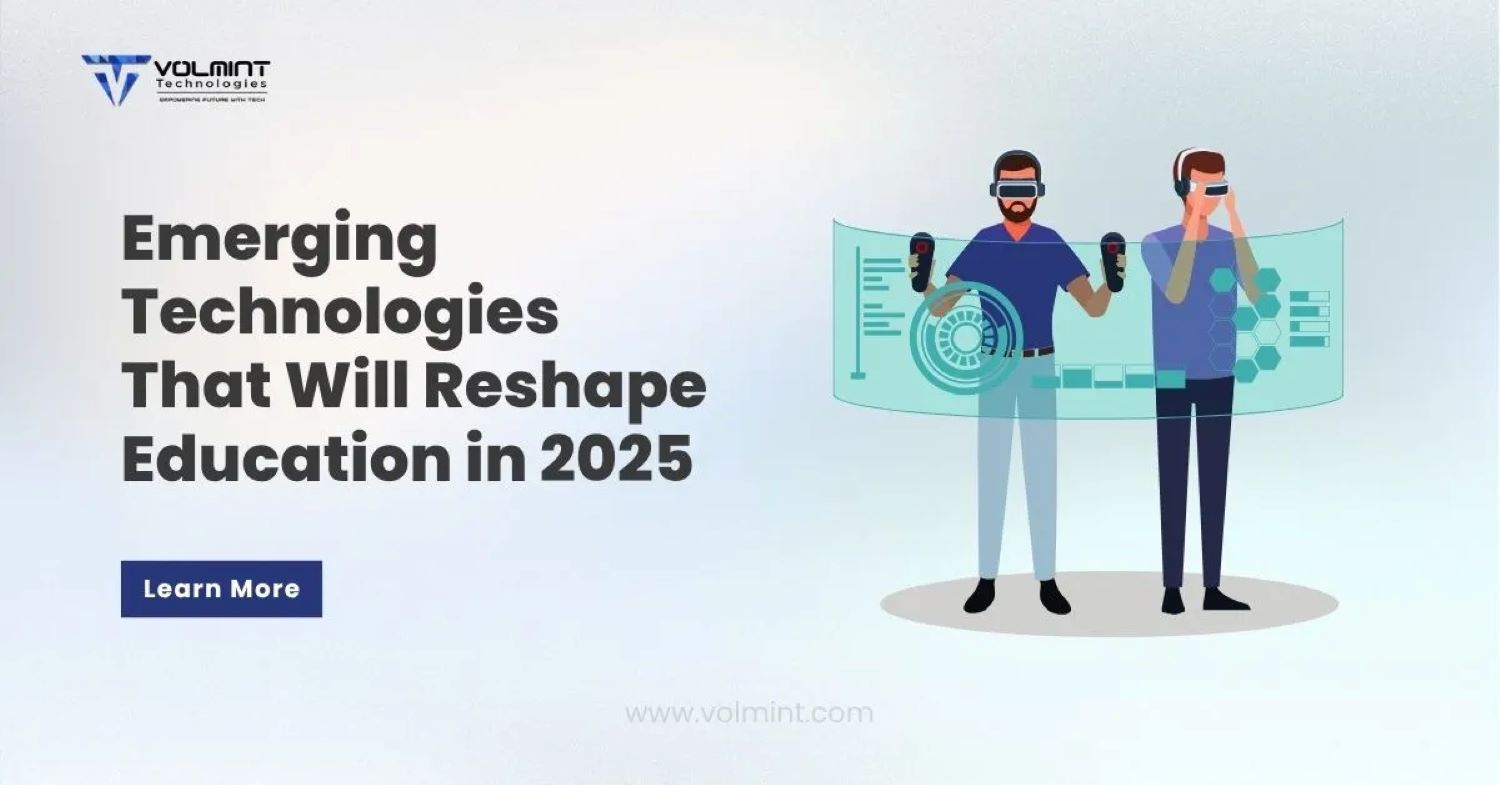
Emerging Technologies That Will Reshape Education in 2025

Emerging Technologies That Will Reshape Education in 2025

While we are discussing emerging technologies, we can’t ignore the fact that endless innovations introduce on daily basis. The world has drawn towards technology and diversified a lot and education is no exception. We should not surprise as different kinds of technologies appear every year that promotes a huge change throughout the world.

Education is one of the most essential parts of society that play a vital role in development and growth in any aspect. However, as a student, there are several challenges and difficulties even if we are focusing on online/distance learning.

Thanks to the various tools and systems that have been created to ensure smooth learning, unlike the past hustles. Learning has never been simpler than it is today thanks to digital platforms. Due to these significant changes that, various technologies have brought about, the global educational system is what it is today. If you are aware of this, you should also be aware that new technology initiatives are ongoing and will undoubtedly transform education by 2025.

Through this article, we have enlightened new technologies that will be the future of Education.

To revolutionize the new way of learning, emerging technologies in education focus on objectives; processes, and knowledge. Education will undoubtedly change as a result of the technology that dominates our contemporary environment.

We must examine each upcoming technology more closely to provide you with more information on which of them will assist to transform education in 2025. Let's get to it:

Artificial Intelligence (AI) Based Education Technologies

AI is one of the best and most discussed innovations the world has. The world now has faith in its technology because of its clever approach to a variety of systems. Although they are employed in many different industries, AI and machine learning are not only for the classroom. More specifically, its existence has aided in the growth of the planet, and fortunately, by 2025, education is expected to go even more as a result.

AI will transform schooling by 2025. The most likely way that it will do this is via promoting the sharing of first-person viewpoints. While writing essays, term papers, or research papers about a particular culture or tradition, students may find this to be helpful. For instance, the Google bot and the majority of search bots will try to parse out a summary from an internet search. A better situation would, however, involve the pooling of personal accounts. And this is what AI hopes to do.
Augmented Reality (AR)

With the use of augmented reality (AR), users may interact with virtual things in a real-world setting by superimposing computer-generated pictures on top of the actual world. By enabling a more immersive and dynamic learning environment, augmented reality (AR) has the potential to revolutionize education. Virtual labs, simulations, and other interactive learning opportunities may be produced with AR.

Also, AR may be utilized to give students individualized evaluations and feedback. Although augmented reality is still in its early phases of development, its applications in education are visible. For the primary purpose of enhancing students' learning processes, it claims to assist students in capturing such ideas by 2025.

5G Technologies

promising wireless technology with high speed and minimal latency the fifth-generation (5G) network has the potential to increase the variety of linked devices and technologies available in classrooms. The technology is all ready to change the way educational institutions connect while also increasing IoT capacity by enabling faster downloads and greater efficiency.

Universities have already started deploying IoT integration for higher education, allowing for the facilitation of debates on specialized subjects through immersive virtual reality experiences that support a range of student learning requirements. Better engagement is achieved with seamless connectivity, bridging the learning gaps for overseas students.

Automation

A significant portion of our modern environment is driven by automation. As involvement increases, business and economic sectors use automation to better deliver speedier experiences. The benefits of automation will undoubtedly be felt in the education industry by 2025. Students have a higher possibility of automatically obtaining lectures at predetermined intervals using automation. You can digitally arrange lectures. Not to mention that automation makes it easier to apply artificial intelligence in better ways.

Customization-Based Education

People should anticipate competency-based education to play a significant part in the educational system by 2025. Students are matched with learning activities appropriate to their level of competence thanks to this unique technology. A method for students to enhance their learning experience based on their capacity to master a skill is provided by competency-based education, in more detail. Students can learn at their own pace regardless of the setting because of this. Students may effectively provide superior results through competency-based education. It is beneficial to assess results that are only based on a student's precise display of competence in a certain field.

Internet of Things

IoT is essentially a method for transforming commonplace items into digital data gatherers and sharers. When utilized to construct more intelligent and connected classrooms, IoT has enormous promise. When they are connected mysteriously, it helps schools and kids stay secure while offering evident savings in terms of energy and lighting.

Both students and visitors would benefit from the strategic placement of security elements like illumination and the use of sensors to monitor traffic around the campus. Using real-time communication capabilities, homework assignments may be sent to parents. In particular, for the student who lacks communication skills, parents may remain on top of all academic needs in this way. Likewise, time-stamp technology may be used to detect absence, apathy, or differences in educational requirements. As IoT links and involves everyone in a student's education, it helps with all practical answers.

Learning Analytics

To better comprehend results, learning is a very wide process that calls for effective tracking and analysis. Teachers are increasingly using learning analytics, a new tool, to track students learning patterns. The majority of teachers will have the opportunity to make specific modifications to courses as a result of tracking student learning rates and behavior. Improvement is a crucial element in education that supports each student's learning experience. Here is how teachers can educate their students with the aid of learning analytics. Fortunately, this technology will be extensively deployed by 2025.

Conclusion

In conclusion, several upcoming technologies are expected to significantly alter the way that education is provided. By researching each of the aforementioned technologies, students may use them more effectively. They gain unique insights on how to make the most of each one by investigating each one. On the other hand, instructors may improve the learning environment by utilizing online course platforms.

More Blogs

Let's Connect for Technological Brilliance

Reach Out to Volmint Technologies Today and Unleash the Power of Customized Solutions Tailored to Elevate Your Business.

Contact Us
Footer Background Circle